Americans with Disabilities Act claims are among the most fact-intensive disputes in employment law. Unlike cases that turn on a single decision or a clear written policy, ADA reasonable accommodation disputes almost always come down to a sequence of events: who said what, when they said it, what the employer did next, and how long each step took.
That sequence lives in email.
For HR professionals, email is where the interactive process gets documented -- or fails to get documented. For employment attorneys on either side, the email record is often the first thing requested in discovery and the last thing argued over at trial. Understanding how email evidence in ADA reasonable accommodation disputes gets used, preserved, and presented is essential for anyone handling these claims.
Why the ADA Interactive Process Is So Dependent on Email
The ADA does not require employers to grant every accommodation request. It requires employers to engage in a good-faith interactive process with the employee to identify what accommodations might work. That process can be informal, but it must be real.
When a dispute arises over whether the interactive process happened at all -- or happened in good faith -- the email record is the proof. Verbal conversations are hard to reconstruct and easy to dispute. Emails are timestamped, searchable, and preserved. A well-documented email thread showing a timely, thoughtful exchange between HR, the employee, and management is powerful evidence that the employer took its obligations seriously. A thin or nonexistent email record, or one that shows long delays and one-sided communication, tells the opposite story.
Courts have repeatedly held that an employer's failure to engage in the interactive process is itself evidence of bad faith, even when a reasonable accommodation might have existed. The email trail is where good faith lives or dies.
The Core Questions Email Evidence Answers in ADA Cases
Did the employer have notice of the disability?
The ADA's accommodation obligation is triggered when an employer knows -- or has reason to know -- that an employee has a disability and may need accommodation. Notice does not have to come in a formal written request. An employee who tells their manager over email that they are dealing with a serious health condition affecting their ability to work has put the employer on notice, even if they never used the words "disability" or "accommodation."
In litigation, the question of when notice was given is often contested. The email record resolves it. An employer who claims it did not know about a disability until a formal EEOC complaint was filed will have a difficult time explaining internal emails from months earlier discussing the employee's medical situation.
Was an accommodation requested, and what exactly was asked for?
Accommodation requests do not need to be formal or use magic words. An employee who emails HR asking to work from home because of a chronic condition, or who asks a manager for a schedule adjustment to attend medical appointments, has made a covered request. The email captures both the request and the employee's characterization of what they need.
This matters because scope disputes are common. An employer may claim it offered a reasonable accommodation; the employee may claim the offered accommodation did not address what they actually requested. The original email request and every subsequent exchange help the factfinder understand what was actually on the table.
How long did the employer take to respond?
Unreasonable delay in responding to an accommodation request can itself be an ADA violation. Courts have found that delays of weeks or months without explanation indicate bad faith, even when an accommodation was eventually granted.
The email record answers this question with precision. If an accommodation request was submitted on a Tuesday and HR did not respond until five weeks later, that gap is visible in the thread. If the employee followed up repeatedly and the employer's emails contain vague language about "looking into it," that pattern is significant. Conversely, if HR responded promptly and documented each step of its analysis, those timestamps support a good-faith defense.
What happened during the interactive process?
The interactive process is supposed to be a dialogue. Employers are expected to ask clarifying questions, explore alternatives, consult with medical providers when appropriate, and document their reasoning. Employees are expected to cooperate and provide the information the employer needs to evaluate the request.
All of this should be in writing. Emails documenting conversations with the employee, requests for medical documentation, consultations with department heads about operational feasibility, and offers of alternative accommodations all form the record of whether the process was real. An employer whose interactive process consisted of a single five-minute phone call with no follow-up email will have a harder time defending a failure-to-accommodate claim than one who documented a multi-week, multi-party exchange.
Was there any adverse action after the accommodation request?
Retaliation under the ADA follows the same evidentiary pattern as other protected-activity retaliation claims. If an employee requested an accommodation and subsequently faced termination, demotion, a negative performance review, or a change in working conditions, the email record is the first place attorneys look for a connection.
Two things matter most: timing and pretextual explanations. If disciplinary emails surface only after an accommodation request was made, or if the stated reason for an adverse action conflicts with what earlier emails show about the employee's performance, those inconsistencies carry weight. Plaintiffs' attorneys call this the "paper trail that appeared too late." Defense attorneys look for the same thing to distinguish legitimate performance management from retaliatory conduct.
What HR Should Document Throughout the Accommodation Process
The single biggest mistake HR teams make in ADA accommodation disputes is treating the process as informal. A phone call with the employee, a conversation with the manager, a verbal okay from legal -- none of that creates a defensible record. Email does.
Every step of the interactive process should generate a written record:
At intake: Confirm receipt of the accommodation request in writing. Even if the request came verbally, follow up with an email summarizing what you understood the employee to be asking for and what the next steps are.
During the process: Document every substantive communication with the employee, every request for medical documentation, every consultation with the employee's supervisor or department head, and every option you considered and why.
At decision: Whether you are granting the request, offering an alternative, or denying it, put the decision in writing with a clear explanation. If you are denying it, document why the requested accommodation would cause undue hardship. Vague denial emails create more problems than they solve.
If the situation changes: If an accommodation is granted and later modified or revoked, document the reason in writing at the time. An email explaining a change is far more credible than a verbal account reconstructed in litigation.
What Employment Attorneys Look for in Discovery
When an ADA accommodation dispute reaches the discovery phase, employment attorneys on both sides issue document requests targeting the email record. The specific items they are looking for follow a predictable pattern.
For the plaintiff's attorney: all emails involving the employee from the date of the accommodation request (or earlier, if notice is disputed) through the date of the adverse action or EEOC charge; all internal communications among HR, managers, and legal about the employee's request; any emails discussing the employee's performance, attendance, or conduct that were created after the request was made; and any communications with the employee's healthcare provider.
For the defense attorney: emails showing the employee's cooperation during the interactive process; documentation of alternative accommodations offered and the employee's response; emails showing that any adverse action was based on pre-existing performance concerns documented before the accommodation request; and records showing that the same accommodation decisions were applied consistently to other employees.
The most dangerous scenario for employers is a gap in the record. Missing emails, inconsistent timestamps, or a thread that simply stops at a critical moment invite adverse inference arguments. Courts and juries draw conclusions from silence.
Building a Clear Timeline Before Litigation
Whether you are an HR professional preparing for a potential claim or an attorney who just received a complaint, the first practical step is the same: build a chronological record of every relevant communication.
This sounds simple, but in practice it means pulling email threads across multiple accounts (the employee's, the supervisor's, HR's, and possibly legal's), reconstructing the sequence of events in order, and identifying the gaps.
Doing this manually -- downloading attachments, sorting by date, cross-referencing threads across accounts -- is time-consuming and error-prone. Important emails get missed. The chronology gets assembled piecemeal. When the threads involve forwarded messages, calendar invites, and replies that changed the subject line, the reconstruction becomes even harder.
ThreadLine is built for exactly this task. Upload the relevant email threads and ThreadLine generates a clean chronological timeline showing every message in sequence, with senders, recipients, and timestamps clearly displayed. The result is shareable, exportable to PDF, and formatted for use in legal proceedings or internal HR investigations.
For ADA accommodation disputes, where the entire case often rests on who said what and in what order, a clear email timeline is not just useful -- it is the foundation of the record.
The Bottom Line
Email evidence in ADA reasonable accommodation disputes is not a peripheral concern. It is the primary record of whether the employer met its obligations under the law. For HR teams, that means treating every accommodation interaction as a documentation exercise from day one. For employment attorneys, it means building the timeline early and understanding what the gaps mean.
The employers who prevail in ADA accommodation disputes are almost always the ones who created a clear, contemporaneous written record of a real, good-faith process. The ones who struggle are the ones who relied on phone calls, verbal agreements, and undocumented decisions -- and are left reconstructing events from memory when litigation begins.
If you are building the email timeline for an ADA accommodation dispute, ThreadLine can help. Upload your email threads and get a clean, shareable chronology in minutes -- no manual sorting required. The first timeline is free.
FAQ
Why is email evidence important in ADA accommodation disputes?
Email often shows when the employer had notice, what accommodation was requested, how the interactive process unfolded, and whether any adverse action followed.
What should HR document during the ADA interactive process?
HR should document the request, dates, participants, medical or job information requested, interim measures, proposed accommodations, decisions, and follow-up.
Can employees organize accommodation emails before speaking with counsel?
Yes. Individuals can build a factual chronology of requests, responses, delays, and outcomes so an attorney or advocate can evaluate the record more quickly.
Related reading
- Document employee misconduct email
- Email evidence in employment discrimination
- Email evidence in wrongful termination
- Organize emails for a custody case
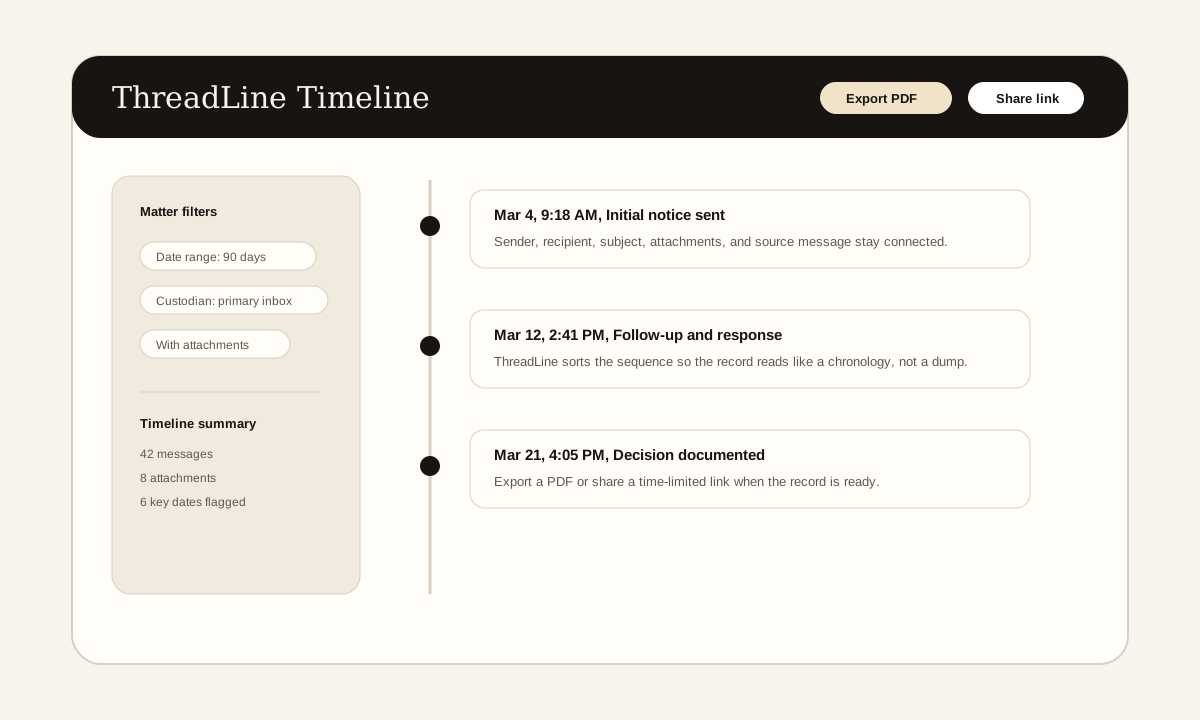
The screenshot above is a product example of the timeline view these articles describe: messages in order, source context preserved, and export or sharing controls available when the record is ready.
Ready to organize the email record for this matter?
ThreadLine turns scattered emails into a clean, chronological timeline your HR team or legal counsel can actually use. Audit-ready, shareable, and exportable in minutes. First timeline is free.
Working an active case? A $49 Case Pass covers 90 days with no subscription.
Need to organize the record first? Get the free dispute documentation checklist.
← Back to all posts