Email Is Everywhere in Litigation -- Until Courts Push Back
In modern civil litigation, email is the record. Contracts are negotiated over email. Instructions are given over email. Complaints are filed over email. Decisions that determine liability are documented nowhere else.
But email's ubiquity in business does not make it automatically admissible in court. Attorneys who assume that a damaging email will simply walk into evidence on its own often find themselves scrambling through authentication challenges, hearsay objections, and best evidence disputes at exactly the wrong moment. Understanding the admissibility of email evidence is not optional preparation -- it is essential case strategy.
This guide covers the core requirements for getting email admitted, the objections you will face, and what courts have actually held when parties fight over email evidence.
The Foundation: Email Is Treated as a Writing
Under the Federal Rules of Evidence and most state counterparts, email is treated as a writing. That means the rules governing documents -- authentication, best evidence, hearsay -- apply directly.
The starting point is Rule 901: evidence must be authenticated before it is admitted. For email, that means showing the court that the document is what it claims to be. A string of characters asserting "From: jane.doe@company.com" does not prove Jane Doe sent the message. Authentication requires evidence that bridges that gap.
Courts have accepted several methods for authenticating email:
Testimony from the sender or recipient. A witness who sent or received the email can identify it, confirm the address, and verify the content. This is the most common approach and usually sufficient for straightforward communications.
Distinctive characteristics. Under Rule 901(b)(4), evidence can be authenticated by its own content when that content, taken together with circumstances, makes authentication sufficiently clear. An email that references specific private facts, uses a consistent signature block, or responds directly to an earlier communication may authenticate itself in context.
Metadata. Email headers contain timestamps, routing information, server data, and sender and recipient identifiers that technical witnesses can explain. In disputes where the sender's identity is genuinely contested, metadata evidence often resolves the question.
Business records certification. Email extracted from a corporate email system and produced pursuant to a proper litigation hold can be certified as business records by a records custodian, establishing authenticity through the records process rather than individual witness testimony.
Hash values and forensic verification. In cases where chain of custody is contested, forensic methods can verify that the email produced is an unaltered copy of the email as it existed in the original system.
The choice of authentication method depends on how contested the evidence is. For routine emails in cases where authenticity is not a live issue, basic witness identification is enough. For emails where the opposing party has raised serious authenticity challenges, technical evidence may be necessary.
Hearsay: The Objection That Trips Up Most Attorneys
Even a properly authenticated email faces the hearsay gauntlet. Hearsay is an out-of-court statement offered to prove the truth of the matter asserted. An email is almost always an out-of-court statement. Whether it is hearsay depends on what you are offering it to prove.
When Email Is Not Hearsay
Email is not hearsay when it is not offered for the truth of its contents. Common non-hearsay uses include:
Verbal acts. An email that makes an offer, issues an instruction, or constitutes a legal act is a verbal act. It is not offered to prove that what was said is true -- it is the act itself. A contractor's email accepting project terms is the acceptance, not a report about an acceptance.
Notice. An email that shows a party had knowledge of a fact is not hearsay when offered to prove notice rather than the underlying fact. A landlord's email acknowledging a tenant's complaint about a defective condition shows the landlord knew -- regardless of whether the condition description in the email is accurate.
Effect on the listener. An email that caused a recipient to take action is not hearsay when offered to explain that action. An employee who received an email directing specific conduct and followed it can testify to the instruction without the email being hearsay.
Hearsay Exceptions That Apply to Email
When email is offered for the truth of its contents, you need an exception. Several apply frequently:
Business records (Rule 803(6)). This is the workhorse exception for corporate email. A business record is admissible if it was made at or near the time of the event it records, by someone with knowledge, in the course of a regularly conducted business activity. Email fits this description when it documents business decisions, communications, or processes in the ordinary course.
The key requirement is that the record was made in the regular practice of the business -- not created specifically in anticipation of litigation. Courts have found that routine operational emails satisfy this standard, while emails exchanged specifically to build a litigation narrative may not.
Admission by party opponent (Rule 801(d)(2)). An email sent by a party to the litigation is not hearsay when offered against that party. This is technically an exclusion from the definition of hearsay rather than an exception. Party admissions are among the most powerful and frequently used bases for admitting email evidence. An employer's email documenting a termination decision is an admission when offered by the terminated employee.
Excited utterance (Rule 803(2)). An email sent immediately following a startling event, while the sender was still under the stress of that event, may qualify as an excited utterance. This exception requires a close temporal relationship between the event and the statement, which is often harder to establish for email than for spoken statements, but it applies when the circumstances fit.
State of mind (Rule 803(3)). An email expressing the sender's then-existing mental state, intent, or plan is admissible under this exception. A manager's email stating an intent to handle a performance issue a certain way is evidence of that intent, not just a statement about intent.
Present sense impression (Rule 803(1)). An email describing an event while it is occurring or immediately afterward may qualify, though courts apply this exception more strictly to email than to contemporaneous oral statements given the ease of crafting email text after the fact.
Best Evidence and the Original Email Problem
Rule 1002 requires production of the original of a writing to prove its content. For email, this raises a question: what is the original?
Courts have generally held that a printed copy of an email is admissible as long as the proponent can show it accurately represents the email as it existed in the system. Metadata, headers, and forensic verification can support that showing. The original is most relevant when authenticity or alteration is contested -- if the opposing party claims the printed version was modified, you need to be able to demonstrate the email's integrity.
For this reason, preserving email in native format (rather than just printing it) is best practice. Native format retains metadata that printed copies strip out, and that metadata may be essential to resolving authenticity challenges at trial.
Common Grounds for Exclusion
Beyond authentication and hearsay, courts have excluded email evidence on several other grounds attorneys should anticipate:
Unfair prejudice under Rule 403. Even relevant, authenticated, non-hearsay email can be excluded if its prejudicial effect substantially outweighs its probative value. Inflammatory internal emails that are only marginally relevant are vulnerable to this challenge.
Improper use of subsequent remedial measures. Emails documenting changes made after an incident cannot be offered to prove negligence or culpability under Rule 407. This applies frequently in product liability and premises cases.
Privilege. Attorney-client communications and work product retained their protection even when inadvertently produced. Courts have shown little patience for parties who rely on privileged emails without first resolving privilege status. A clawback agreement under Rule 502(d) can protect against inadvertent waiver.
Spoliation-related exclusion. Courts have excluded or limited email evidence where the producing party failed to preserve it properly, and have imposed sanctions including adverse inference instructions where the failure was willful or grossly negligent.
Practical Steps for Getting Email Admitted
The work of admitting email evidence happens long before trial. Here is what that preparation looks like in practice:
Build a complete, chronological record during discovery. Courts and opposing counsel are more likely to challenge email evidence that appears selectively presented. A comprehensive, organized email production -- one that shows the full timeline of relevant communications -- is harder to attack than a handful of cherry-picked messages.
Preserve metadata. Authenticate email in native format whenever possible. Metadata is your backup when a witness is unavailable or credibility is contested. Strip it and you may lose the ability to verify timestamps and sender identity.
Prepare your authentication witness. Decide early who will authenticate each significant email. Match the witness to the authentication method: a records custodian for business records, a participant for personal communications.
Anticipate hearsay objections and map your responses. For each major email, identify the hearsay issue and the applicable exception before you brief the court. Judges expect this analysis. Counsel who can immediately explain the basis for admission are taken more seriously than those who respond reactively to objections.
Understand the opposing party's email record too. The admissibility of email evidence is not a one-way issue. Understanding what the other side's email record looks like, including what it is missing, helps you frame authenticity challenges and identify preservation failures worth pursuing.
How ThreadLine Helps
Organizing email evidence for admissibility purposes requires more than a pile of printed messages. It requires a chronological record that shows context, timestamps relationships between messages, and supports the foundation you need to get evidence admitted.
ThreadLine turns messy email threads into clean, timestamped chronological timelines you can use directly in investigation, privilege review, and trial preparation. Connect any IMAP account -- Gmail, Outlook, or any provider -- specify your custodians and date range, and get a court-ready record in minutes instead of hours.
The first timeline is free. Start at threadline.app -- no credit card required.
FAQ
Are emails admissible in court?
Emails can be admissible in court if the proponent can authenticate them, address hearsay objections, satisfy relevance rules, and provide the best available version of the record.
Are emails hearsay?
Emails can contain hearsay, but some statements are not offered for their truth and others may fit exceptions such as business records, admissions, notice, or state of mind.
How do you authenticate an email in court?
Authentication can rely on witness testimony, metadata, distinctive characteristics, reply context, business records, stipulation, or other evidence showing the message is what it claims to be.
Related reading
- Email metadata in litigation
- Court-ready email exhibits
- Email chain of custody
- Email chronology for court
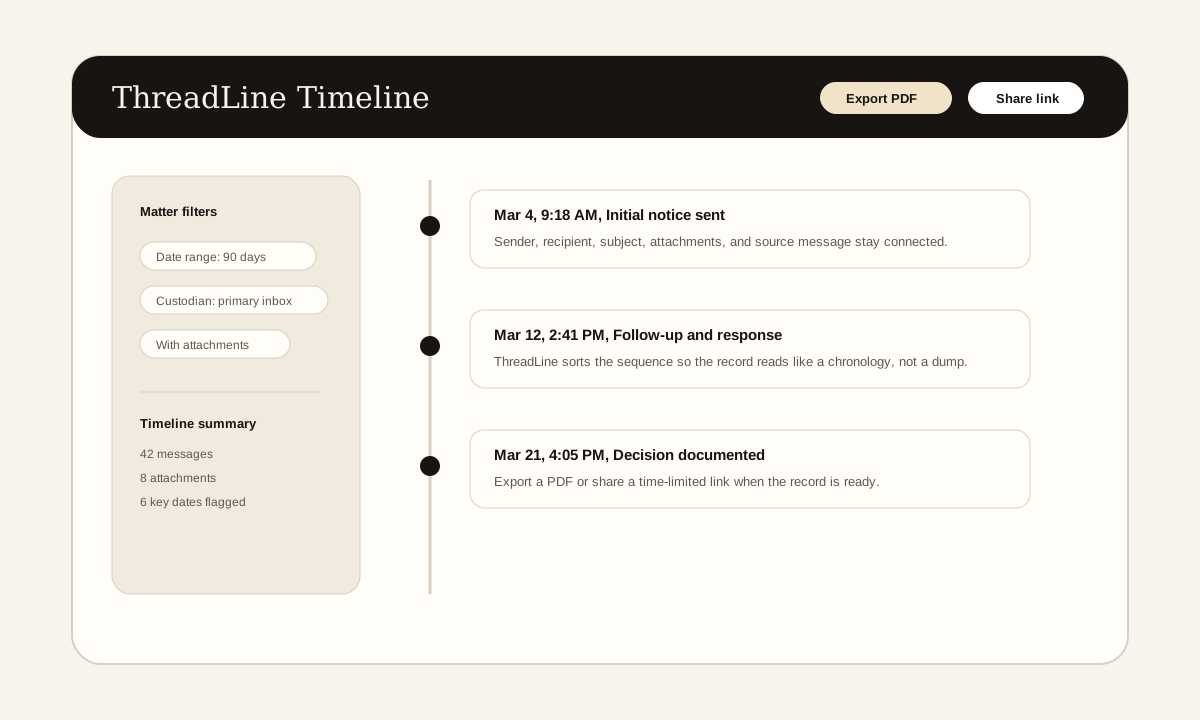
The screenshot above is a product example of the timeline view these articles describe: messages in order, source context preserved, and export or sharing controls available when the record is ready.
Need a clean email record without enterprise pricing?
ThreadLine gives small firms a court-ready email timeline in minutes. No Relativity, no per-gigabyte fees, just a clear, chronological record you can share or export. First timeline is free.
Working an active case? A $49 Case Pass covers 90 days with no subscription.
Need to organize the record first? Get the free dispute documentation checklist.
← Back to all posts